PRIDE AND PREJUDICE

Updated: Jul 2, 2021
Awaam conducted an informal, anonymous survey to understand the student body's opinions and reactions towards the LGBTQIA++ community in India. Our survey received 60 responses which were lower than the previous surveys. We believe that the low response rate is significant and indicative of a lack of interest and stigma about issues related to the queer community.
Approximately 63% of the sample reported knowing someone who identifies as part of the Queer Community. This implies a certain level of mainstreaming of atypical gender and sexual identities amongst college-going students.

General Attitude towards the Queer Community
Around 13% of the sample identified themselves as part of the LGBTQIA++ Community. Our survey showed that 65% of the sample believed that their family would not be supportive if they came out as queer. Meanwhile, 55% of the sample believed that their friends would be supportive if they came out to them. This implies a high degree of societal stigma and bias against the LGBTQIA++ community among older members of society. This may be due to a relative lack of sex education and awareness about the LGBTQIA++ community, especially amongst older adults in India. This is in line with respondents who identified as part of the LGBTQIA++ community, out of whom a majority (75%) had only come to close friends, but not family. These results reveal a disturbing trend of young adults being unable to confide in their families regarding important parts of their identity, which may exacerbate feelings of isolation or loneliness.


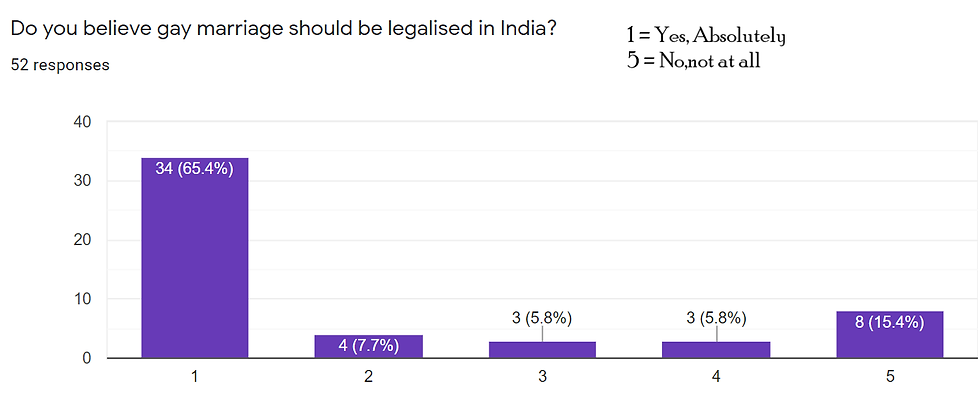
65% of the sample believed that gay marriage should be legalised. However, it is important to note that nearly 15% of the sample also believed the opposite. In February 2021, a petition was raised regarding the recognition of same-sex marriages in India. The Centre responded to the petition by stating, "Living together as partners and having sexual relationship by same-sex individuals [which is decriminalised now] is not comparable with the Indian family unit concept of a husband, a wife and children, which necessarily presupposes a biological man as a 'husband', a biological woman as a 'wife' and the children born out of the union between the two." This represents a very narrow understanding of marriage by the state. the Centre also stated that "the Supreme Court judgment in the Navtej Singh Johar case does not extend the right to privacy to include a fundamental right in the nature of a right to marry by two individuals of same gender".
Therefore, our survey results indicate a greater need for personal and civil liberties towards the LGBTQIA++ Community as opposed to the Centre's position. The discord between the general public and the state can be observed through the responses to our item on policies regarding the LGBTQIA++ community. Nearly 62% of the respondents believe that the queer community is not well protected under the laws of the Indian government.
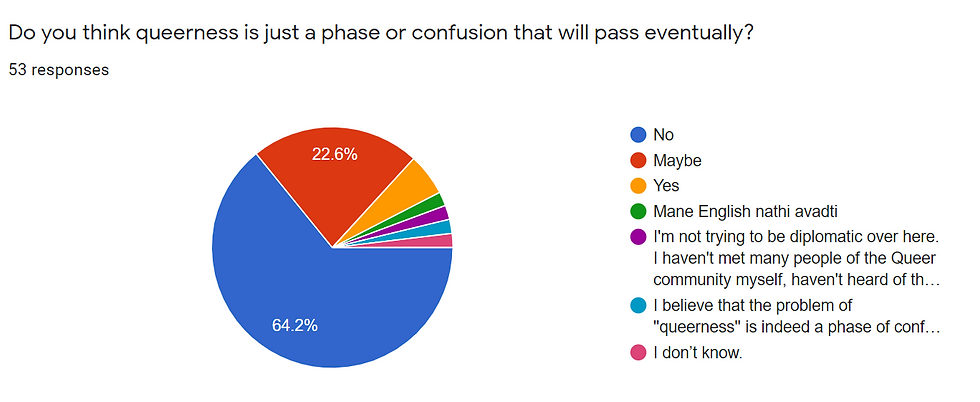
Approximately 83% of the sample believed that members of the LGBTQIA++ Community are not diseased. However, 8% of the sample did believe that queerness is a disease. Moreover, nearly 28 % of the sample believed that members of the LGBTQIA++ community might be going through a phase of confusion in their lives. These figures point towards a surprising lack of awareness which is even more alarming given that our sample was mainly composed of young, educated individuals.

Almost 35% of the sample also believed that members of the LGBTQIA community could be identified through their behaviour or clothing. This may occur because pop culture and media have traditionally depicted queer characters as effeminate or having a loud, flamboyant style of dressing or appearance. This points towards a lack of appropriate representation of the queer community in the media and mainstream television. It is also corroborated by 67% of the sample agreeing that the queer community is not well represented in the media today. The rise of OTT platforms has brought out stories of the queer community and helped in mainstreaming non-stereotypical portrayals of characters belonging to the LGBTQIA++ community. Recent Bollywood movies like Ek Ladki Ko Dekha Toh Aisa Laga, Shubh Mangal Zyada Saavdhaan, Aligarh, Kapoor and Sons, etc., have shown top leads portraying queer stories. Unfortunately, these roles are still occupied by mostly cis-gendered heterosexual males. This implies that casting members of the LGBTQIA++ community in lead roles is still not commercially viable and subject to public stigma.

Almost 70% of the sample agreed that children in schools should be taught about sexuality and be given proper sex education. Though the New Education Policy Draft talks about several supposedly progressive reforms to the Indian education system, there is no mention of a standardized curriculum for sex education across the country. Teaching children about consent, sexuality, and gender could make large inroads for spreading awareness about the LGBTQIA++ community and safe sex in general. 70% of the sample also believed that children should be taught gender-neutral terms, and be encouraged to let go of heteronormative language. Language plays a defining role in how individuals explore and understand the environment around them. Teaching children inclusive language will help in avoiding gendered behaviour, and allow them to explore their gender/sexual identities through the course of their schooling.


What's on the Queer minds?
After getting an idea about the general attitude of IITGN community, we wanted to dig deeper and understand what does the queer community of IITGN has to say about some prevalent misconceptions about them. We also asked them about their experiences of living their lives in a society that is definitely not queer-friendly if not necessarily queerphobic. It was strikingly concerning but not surprising to document that 87.5% of the participants felt unsafe about publicly identifying as queer. Even in this modern age which boasts of its progressiveness, wearing one's queer identity up on the sleeves could very easily be perceived as an invitation for hostile behaviour, queerphobic slurs, and discrimination. This lack of acceptance is so deep-rooted that it usually gets internalised by queer people themselves and becomes a life-long struggle to shrug it off, explore themselves and accept every unconventional aspect of it unapologetically.


We further asked members of LGBTQIA++ community about ways or platforms through which they meet potential partners. Three out of eight respondents reported that they do not seek partners through any medium because they either identify as asexual or find the process too anxiety-provoking. The rest of the participants mentioned social media, social circles, and mutual friends being their refuge in this regard. Finding potential partners in today's world is a challenge regardless of one's sexual orientation but the struggle escalates exponentially when one belongs to a marginalized section of the society. Members of LGBTQIA++ community have always been marginalized because of their atypical identity, it is psychologically draining navigating in a heteronormative world with a constant fear of being discriminated against, humiliated, or dismissed even when they find the courage to put themselves out in the world.
The prevalent stereotypes about the queer community range from genuine confusion to outright disregard of their existence. When we asked about some of these stereotypes that are prevalent in Indian society, the queer community at IITGN responded by sharing their observations and experiences with us. One of the participants pointed out the common stereotypes, " Bisexuals are greedy. Gay people are always feminine. Every relationship should confirm to heteronormative standards. That non-heterosexual non-monogamous people are predatory." It is no news that people still believe that it is a choice to be queer and it's unnatural.
Another participant who identifies as asexual elaborated on some stereotypes about the ace community, "Firstly, the majority population of India is ignorant about the existence of asexuality( too sex-obsessed, idk). Out of those who do know about it, they believe that it's some kind of physical disability of not being able to have sex, some other disorder, trauma response, celibacy, sex hatred or just a phase. Also, there is this misconception that there couldn't be any sex-positive ace. I think asexuality lies at the apex of misunderstanding when it comes to queer identity." The LGBTQIA++ community is mostly talked about in terms of being gay, lesbian, or transgender. There is so much more to know about the gender and sexuality spectrum and hence, we need more grounded and practical strategies to tackle this situation.
Policies, Education and Social Measures
As we have already mentioned that a majority of participants expressed their disbelief about the protection of LGBTQIA++ community under the laws of the Indian government. If we look closely then we can easily derive that even if there were more adequate laws, the issue is more about the societal norms and perception. The logically wise way to deal with such an issue would be to begin from the beginning i.e., to start educating children about the different gender and sexual identities so that they grow up in an informed manner. For elders, there could be social campaigns for awareness and support to build societal acceptance. Efforts to make language more inclusive and teaching inclusive use of language in schools is one way of making sure that nobody feels dismissed or misidentified.
Although the IITGN community mostly responded in a positive way regarding these reforms that are needed in society. There were some concerning comments about educational and social measures where one of the respondents said explicitly, "I don't think it is the role of the schools to help their students to explore their sexual orientation nor it is a school's place to decide what language a student should use outside class." This is just one problematic comment, another respondent went on and said, "The way is to educate children and so minimize "queerness" in them. Not populate the '++' categories. I strongly believe anything besides heterosexuality is an unnatural condition that needs to be treated with care, not to be encouraged." One of the participants took a step ahead and criticized this whole process of creating awareness in the strongest terms by saying, "Leftists like you who spread all types of dirt in an academically sound institution like IIT should be targeted first. Strict laws should be even made for prosecuting those who are into this hysteria of LGBTQ." It is appalling to document that there is a presence of a considerable amount of people with such problematic mindset at a premier institute of India.
However, there were a large number of respondents who left understanding, empathetic and informative comments as well. They talked about adequate representation in government offices and media, policy changes, creating dialogue at our homes, and desensitization programs. Some of the participants accepted their ignorance and refrained from commenting. It will take more time and patience to make things better but it would not be unfair to say that change has already started. It is slow but it is happening.
Finally, it is fairly appropriate that about 50% of our sample believes that society has become more accepting of the queer community than it was a decade ago. At the end of Pride Month, we should acknowledge the great strides we've taken in LGBTQIA++ awareness, from the decriminalisation of Article 377 to the recent Madras court judgment on conversion therapy. However, we need to work towards agitating and organising so that 100% of India feels included within society in the future!

I'm straight, and I have no problems befriending a queer and developing a lasting healthy friendship, so long as my personal space is not invaded(this notion might be my misconception). My only concern is, in the process of educating children, what if their young minds get confused of their natural inborn tendencies towards their self gender identification?
I think this world doesn't need more and more queers amidst a fairly uniform majority of "normals", around whom some necessary, time tested core societal values have been constructed over several millenia. If anything at all, we should strive to teach children to align their sexuality and temparaments (not with forceful assertion of course) with what their bodies "naturally" has to offer. The…