CORONAVIRUS AND THE CAMPUS: OPINIONS ABOUT THE COVID SITUATION AT IIT GANDHINAGAR

Updated: May 17, 2021
We are currently living in stressful and unprecedented times—the number of new COVID-19 cases being reported daily across India seems to be exponentially rising each day, even crossing the 4-lakh mark now. The positivity rates and death rates are rapidly increasing across most states, and questions about the inefficiency of the government’s handling of the 2nd wave of the virus are increasingly being raised. As a member of the IIT Gandhinagar (IITGN) community, one may think, “Well is my campus handling the current situation effectively in the first place? Is it doing enough to control the spread of the virus?” Awaam- The Society and Politics Group at IITGN surveyed the students of the IITGN community to get an idea of how students feel about the campus’ measures at these times. With 148 responses, this is what students have to say.
(Note: - The graphs used below represent an estimate of the agreement to the questions asked, with a score of 1 being complete disagreement and 5 being complete agreement)
Was the survey conducted only for those on campus?
There is enough evidence from the 1st wave of this pandemic that lockdowns and isolation due to restricted access outside of our own homes are devastating to our mental health—especially when the current situation has lasted for over a year and is suddenly worsening. This means that both those on and off campus are under stress, as academic decisions taken based upon the current scenario affect all students. The survey aimed at seeking answers regarding the diverse interests of the IITGN student community.

Although a vast majority of the responses were from those on campus, the survey was not restricted to those on campus alone. 17 responses were from those currently not on campus.
How have the Institute’s measures to tackle the pandemic been perceived?
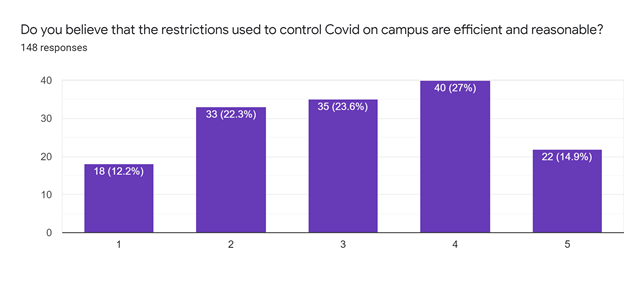

There have been strict mask enforcement rules, with hefty fines for offenders, which made everyone wear masks whenever they ventured outside their hostel rooms. Incidents of anonymous reporting of those violating the norms have also been common albeit raised privacy concerns among students. Also, the institute provided sanitizers at every location—at the hostel entrances, mess halls, and the library, and removed outdoor seating. The institute has also tried to restrict inter-hostel movement and gatherings of multiple students within the same hostel rooms. Social distancing norms weren’t so rigorously practiced, and students were allowed to travel to the cities of Gandhinagar and Ahmedabad till about a month back. Visitors from outside were also allowed to enter the campus as well. This resulted in a spike in the number of COVID-19 cases on campus.
Since there are separate restrictions levelled on staff members and students, students might have a critical attitude towards most of the restrictions. This is is reflected in the 2-4 agreement score to the former question (of the two graphs above). The institute could consider engaging with the student community, and have a more open dialogue about the restrictions which students are comfortable in following. The prevention of Covid-19 is dependent upon adherence to social distancing norms, and perceived unreasonability of the restrictions could drive lower compliance and more unsafe behaviour. It is also possible that the lack of a structured plan for dealing with spikes in coronavirus cases on campus could have made students critical about the institute’s restrictions.
On the contrary, there is a lot more consensus that the rising number of cases has been controlled fairly efficiently by the institute. This could be the case as IITGN had made the guest house facilities available for COVID positive patients, isolating them from the rest of the community effectively. Also, the institute has aggressively quarantined primary contacts, ensuring they test negative before releasing them. But has the virus-spread actually been contained? This brings us to the next question at hand.
Has the college been transparent enough about the current COVID crisis on campus?
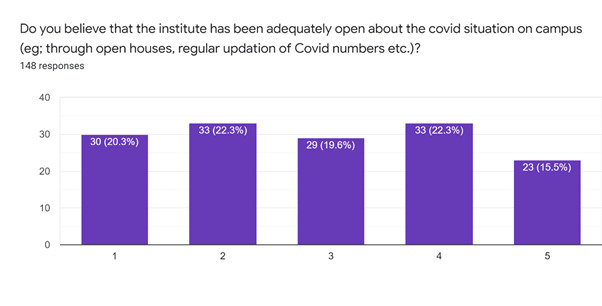
There is a slight majority in the number of people who think that the institute has not been adequately open about the covid scenario on campus. There is a web page maintained by IITGN where students can see the current number of active cases and open house programs that are conducted at regular intervals. The institute could consider a more regular updation of the Google Doc for Covid-19 cases and include the total number of cases on campus (including housing, staff, and students who have tested positive). Greater clarity around the source of the Covid-19 vaccination drive and information surrounding the second dose of the vaccine could also help to allay concerns around transparency in the campus. If the situation is much worse than it is portrayed through the data, it would be in the best interests of the student community to make it completely transparent so that there is no holding back of information and the gravity of the situation is not whitewashed.
What do students feel in these times?
With the mode of learning being wholly online and extensive isolation times, it is no doubt that students are mentally stressed, which gets reflected in their academic performances. Our data, too, tells the same, with an overwhelming 86% of students feeling this to be the case. Though the institute has extended the deadlines of grade submission, the academic load could be further reduced given that several individuals inside and outside of campus are facing covid-related issues in a bigger manner than before. A number of extraneous factors outside anyone’s control have surfaced for everyone to deal with. Students might get overwhelmed and develop an indifferent attitude towards their academic obligations. Thus, relaxation of attendance requirements, take-home tests, and extrapolation of grades in cases where students are grievously affected could be considered.

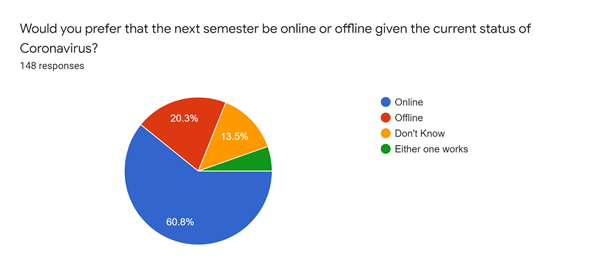
Around 61% of students want an online semester next semester based on the current COVID crisis in the country. This may deleteriously impact lab work and professional training of students on a long-term basis. However, offline classes do not seem feasible given the current situation surrounding coronavirus all over India. The institute could consider hybrid modes of learning in the next few months if cases around India happen to stabilize and vaccination is carried out. Most of the times, when both mental and physical health is threatened in any scenario, mental health issues tend to get ignored. Stronger outreach from the Counselling centre could help to prevent the mental health crisis emerging from the surge in cases.
As to the question of whether it is safer to stay on campus currently, there is a slight majority in the number of students who agree with this. This implies that the student community has expressed a degree of confidence in the institute’s handling of coronavirus. The student community acknowledges that the measures undertaken regarding social distancing and mask-wearing are more stringent inside the campus, which have led to a safer environment.

Other suggestions posed by students:
Many students feel that only restricting students’ movement outside the campus and not restricting the movements of faculty and staff is not an ideal measure to take, as the virus does not differentiate between any of us. As expected, there is a considerable number of positive cases amongst the faculty and staff communities.
The student mess halls were also considered unsafe places as they crowded during peak hours, making social distancing protocols very unfeasible. To manage this, the institute had recently made a slot-based accommodation for the students, wherein a fixed number of students would be given specific time slots to have their meals, and there were two such slots made.
Shared bathrooms are vulnerable places for spreading the virus as multiple contact points cannot be avoided. Some students feel that this could be one reason why the virus is spreading quite rapidly inside the campus, at least amongst the student community. The institute has recommended double masking within washroom premises, but the enforcement of this rule is tricky. Automated touch-free water coolers are expected to be installed in all the hostels and the messes as well, as the buttons of the water coolers act as contact points for the spreading of the virus.
In the recent COVID-19 updates webinar conducted by IITGN, Director Sudhir Jain had made it clear that students will be allowed to leave campus voluntarily and that the institute would help them with necessary procedures. Unlike most other IITs (like IIT-Guwahati and IIT-Kanpur), IIT Gandhinagar has not made it mandatory for its students to leave. Most students were divided in terms of allowing students to stay on campus amidst the surge. The institute could formulate a priority list of cases that can inform students to come back/continue residing on campus. These questions do not have perfect answers, but that does not mean they should be ignored either. Difficult times demand bilateral thinking and an open-minded attitude. The extent to which the institute has been successful in delivering it is a question only time can answer. Let the time tell but be vigilant. Stay safe.
Article Credits: Harshvardhan, MSc Physics, 1rst year, IIT Gandhinagar

Comments